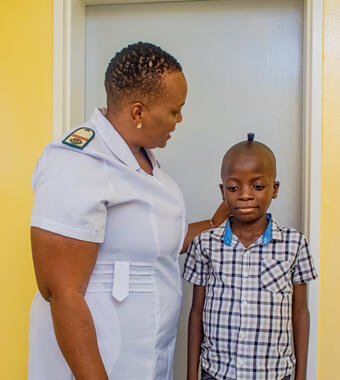

In the rural areas, there is one doctor for 16'000 inhabitants. This is why SolidarMed supports the training of new doctors for the disadvantaged regions of Zambia.
SolidarMed in Zambia
1500 missing doctors Zambia – home of the spectacular Victoria Falls, and where 64 percent of inhabitants live on less than a dollar a day. Low salaries push government medical personnel out of the rural areas and into the towns. To work effectively, the Zambian health system needs around 2300 doctors. In 2007, only 815 positions could be filled. Outside of the larger towns, there is on average one doctor for 16,000 inhabitants. In the remote rural areas the number is much higher. In comparison - in Switzerland 489 people have to “share” one doctor. › WHO Factsheet: Migration of Health Workers › SolidarMed factsheet Zambia
"Non-physician clinicians" for the shortage of personnel in the health sector As a response to the acute shortage of doctors in Zambia, SolidarMed supports the government programme for the training of „non-physician clinicians“, known as Medical Licentiates at Chainama College. This is an additional qualification for trained clinicians (Clinical Officers) with two years work experience. The training is focussed on first aid and emergency care, particularly for women and children. The ML programme is specifically tailored to Zambian needs and the Zambian context.
Local partners in Zambia - Chainama College of Health Sciences www.chainamacollege.com - Ministry of Health of the Republic of Zambia ›www.moh.gov.zm
Training Hospitals: - St. Luke’s Mission Hospital, Mpanshya ›www.stlukesmissionhospital.org - Kafue District Hospital - Livingstone General Hospital
Twice as many doctors per year Since 2009, the number of ML students could be doubled. To achieve this, SolidarMed supports three training hospitals for practical training (Mpanshya, Livingstone and Kafue), which also benefits theoretical training. Through targeted investments SolidarMed ensures the accreditation of these new training hospitals. A SolidarMed advisor supports the College in institutional development. The project is financed by the Liechtenstein Development Service (LED).
SolidarMed's impact.
As part of its efforts to tackle the human resource crisis, the Zambian government has created a human resource working group, in which SolidarMed participates as a partner organisation. SolidarMed’s support of three new training sites has made it possible to admit 24 students into the ML programme on an annual basis. The Ministry of Health has the goal of training 40 students a year, and eventually placing them at district hospital. To achieve this, the necessary structures first need to be created at Chainama College.
For additional information, please contact the Desk Officer for Zambia, Anna Häggblom: › a.haggblom(at)solidarmed.ch, Phone: +41 41 310 66 60
Zambia: Even with its huge deposits of copper, Zambia is one of the poorest countries in Africa. Well-trained staff migrates abroad – to South Africa, Botswana or Europe, including doctors and nurses. They also die of HIV/AIDS: in Zambia 15.2% of adults are HIV positive. Life expectancy has sunk to 48 years. (Source: UNO) ›BBC Country Profile Zambia Health in Zambia Facts & Figures ›WHO Statistics ›map Zambia Waiting room with regional map Jobs in Zambia ›Jobs›Medicus Mundi Bulletin 104/07:Brain Drain: Why do Zambian health workers migrate abroad? › WHO: Factsheet Migration of Health Workers